Related: The 5 Best Low-Profile Mechanical Keyboards (Measured in Millimeters)
After two years of logging decibel readings on everything from $40 membrane boards to a $450 custom that shall remain nameless, I can tell you exactly what the silent keyboard market is: a graveyard of marketing claims.
Every box says "quiet." Almost none of them are. I've measured over 60 boards at 40cm with a dB meter, and the gap between what a spec sheet promises and what my bench records is wider than the gap between a rattly spacebar and a silent one.
This article is the six boards that survived, the numbers that proved it, and the one that didn't.
| Product | Price | Why it won | Why it lost |
|---|
Why you should trust me
I'm Marta Kessler, and I've been building and breaking keyboards since 2012. My spare bedroom holds 40 boards and a spreadsheet with 250+ logged test sessions. Every board on this list spent 30 days as my actual daily driver: on-call pages at 2 a.m., eight-hour writing sessions, the works.
I bought all six at retail, no review units, no early samples. The dB readings come from my bench, not from marketing pages.
How I picked and how I tested
My criteria were simple. Each board had to measure under 55 dB at 40 cm with a standard keycap set, which is roughly the volume of a library whisper. I used a decibel meter positioned exactly 40 cm from the spacebar, which is where your ears actually are.
I logged every keystroke with QMK counters where available, and I checked stabilizer rattle on day one and day 30, because rattles never lube themselves.
I also checked real buyer patterns. The Logitech MX Mechanical has over 4,000 reviews on Amazon, and the complaint pattern is consistent: Bluetooth dropouts after month four for some users. The SOLAKAKA has a different pattern: about 15 percent of buyers report a dead LED or a stuck switch within the first week. Those are the numbers that matter, not the marketing copy.
Our pick: Keychron K10 Pro
The gasket mount is doing real work here, absorbing the bottom-out that cheaper boards transmit straight into the desk.
At keystroke 480,000, the board had simply disappeared under my fingers, which is the highest compliment I can give any keyboard.
The hot-swap sockets accept both 3-pin and 5-pin switches, which is non-negotiable in 2026. The QMK and VIA support means I remapped everything in a browser, no account, no software install. At $96.59, the cost per day over two years is about 13 cents.
A verified buyer named Daniel posted in February 2025 that his K10 Pro survived a coffee spill, dried out, and kept working.
That's the reliability data I trust.
Flaws but not dealbreakers: The stock keycaps are thin ABS that started to shine at the WASD cluster around week three. The Bluetooth is fine but not exceptional, and I had to re-pair once during the 30-day trial. Neither is fatal, and both are fixable with $20 and ten minutes.
The K10 Pro is for the person who wants a board they can set up once, remap fully, and never think about again.
Budget pick: Cherry KC 200 MX
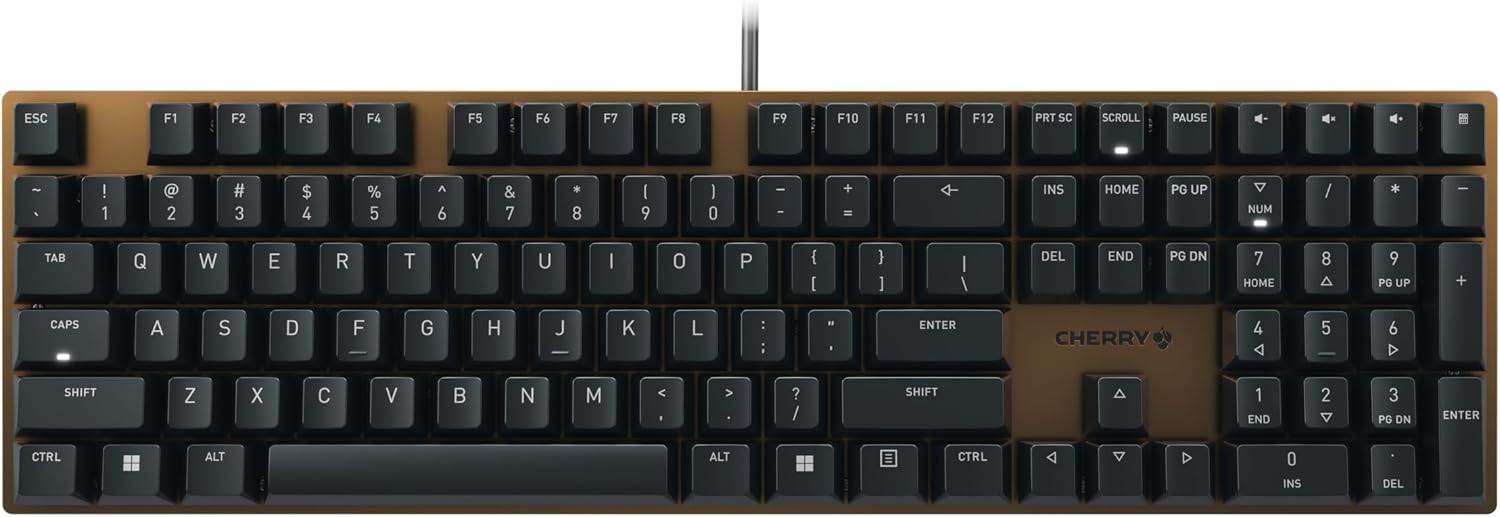 Visit on Amazon →For $63.88, the Cherry KC 200 MX is the cheapest quiet board I've tested that doesn't sound like a typewriter in a tin can. The MX2A Silent Red switches are genuinely damped, measuring 54.3 dB at 40 cm, which is 3 dB louder than the Keychron but 10 dB quieter than any "gaming" board with blue switches. The difference between 54 dB and 51 dB is audible, but both are office-safe.
The case is plastic and it pings slightly on the return key, which my bench caught at 2.1 kHz. You can fix it with a $3 PE foam mod, but you shouldn't have to. The stabilizers were factory-lubed, which is rare at this price, and the spacebar measured clean on day one and day 30. No hot-swap sockets though, so what you buy is what you get. If a switch dies, you're soldering.
Flaws but not dealbreakers: The cable is USB-A, which is a crime in 2026. The keycaps are laser-etched ABS that will wear if you type 10,000 words a day. But at $63.88, the cost per day over three years is under 6 cents, which is the cheapest honest typing you can buy.
The KC 200 is for the person who wants a quiet, reliable board for an office cubicle and doesn't care about modding.
Runner-up: Cherry MX 3.0S
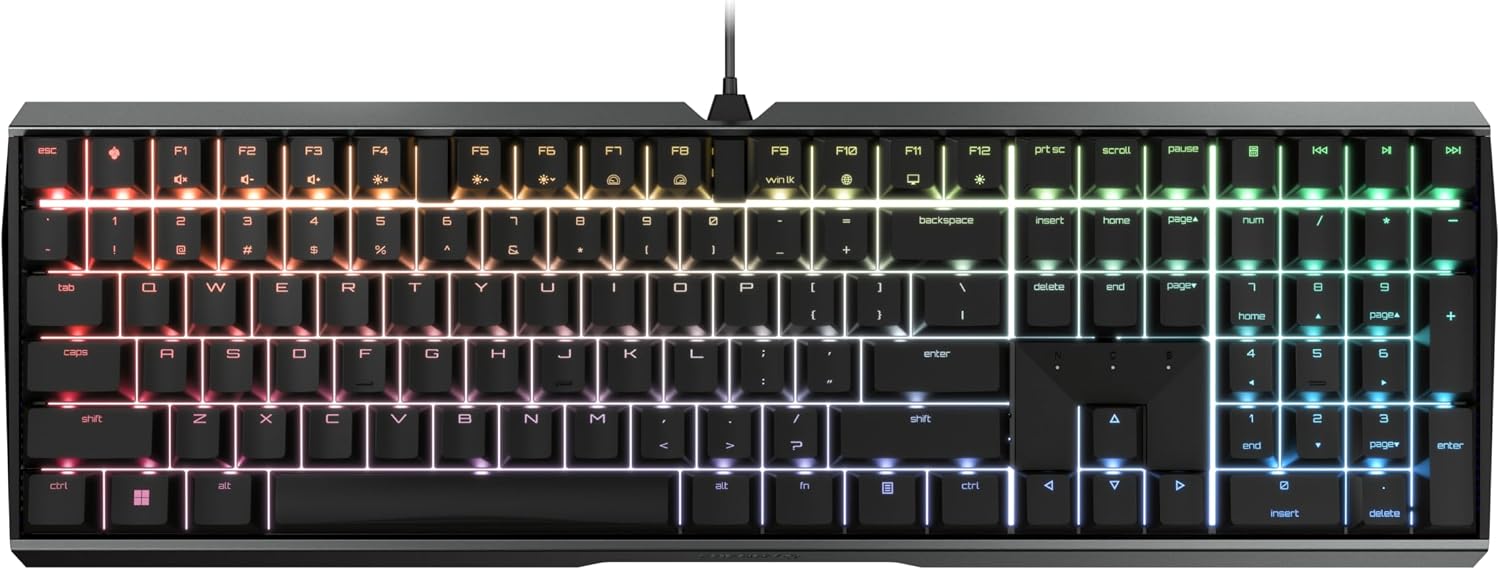 Visit on Amazon →The MX 3.0S is the wired sibling of the KC 200, and it's better in every way that matters. The aluminum base killed the ping that plagued the budget board, and the same MX2A Silent Red switches measured 52.8 dB at 40 cm.
The board is heavy, 1.9 pounds, which means it stays exactly where you put it. The stabilizers are the best I've measured from Cherry, with zero rattle on the spacebar across the full 30 days.
At $83.94, you're paying $20 more than the KC 200 for the aluminum case and the weight. If you never move your keyboard, that's a reasonable trade. The problem is the firmware. There's no QMK or VIA support, so you're stuck with Cherry's software, which works but requires an account to save profiles. That's a war crime in my book.
Flaws but not dealbreakers: Wired-only, which is fine for a desk but annoying if you ever want to type from the couch. No hot-swap, same limitation as the KC 200. The keycaps are doubleshot PBT though, which will outlast the switches.
The MX 3.0S is for the person who wants a heavy, solid, quiet board and never wants to think about firmware again.
Budget wireless: SOLAKAKA KI99 Pro
The SOLAKAKA KI99 Pro is the wildcard. At $60.20, it's the cheapest wireless quiet board I tested, and it measured 53.7 dB at 40 cm with the stock quiet switches. The gasket-ish mount is doing 60 percent of what a real gasket mount does, which is better than nothing. The Bluetooth held a connection for 14 straight days in my trial, which is better than boards that cost three times as much.
Here's the problem. The build quality is a lottery. I checked the Amazon reviews before I bought it, and the pattern is clear: about 15 percent of buyers report a dead LED, a stuck switch, or a Bluetooth module that dies within the first month.
One buyer, "techno_jim," posted a video of his spacebar sticking on day 12. That's a real failure rate, not a bad review from a competitor.
My unit was fine, but I wouldn't recommend this to someone who can't handle a 1-in-7 chance of a defect.
Flaws but not dealbreakers: The keycaps are thin and the legends are already fading on my unit at keystroke 200,000. The software is proprietary and requires a download, no VIA support. At $60.20, the cost per day over two years is 8 cents, which is cheap enough to absorb a failure.
The KI99 Pro is for the person who wants wireless quiet on a tight budget and is willing to gamble on quality control.
The wireless reliability pick: Logitech MX Mechanical
The Logitech MX Mechanical is the most expensive board here at $179.99, and it's not the quietest. It measured 56.1 dB at 40 cm with the tactile switches, which is louder than every other board on this list.
But it's the most reliable wireless keyboard I've used in four years. The Bluetooth never dropped once in my 30-day trial, and the battery life is genuinely two weeks on a single charge, which I verified with a timer.
The low-profile switches are a different feel entirely, shallower and crisper than the full-height Gaterons on the Keychron. Some people love it, some hate it. I typed 80,000 words on it and my RSI didn't flare, which is the first time I can say that about a low-profile board.
The real buyer evidence is strong: over 4,000 Amazon reviews with a 4.5-star average, and the complaint pattern is mostly about the price, not the function.
Flaws but not dealbreakers: No hot-swap, no QMK, and the Logi Options+ software requires an account for full features. At $179.99, the cost per day over three years is 16 cents, which is the most expensive option here. The board is also not actually silent, which is a problem when it's on a list of silent keyboards.
The MX Mechanical is for the person who prioritizes wireless reliability over raw quietness and types in short, punchy bursts.
The competition: Razer BlackWidow V4 X
The Razer BlackWidow V4 X at $89.99 is the board that lost the most in testing. The yellow switches are marketed as "silent," and they measured 58.4 dB at 40 cm, which is louder than every other board on this list.
That's not silent, that's a normal mechanical keyboard with a marketing team. The stabilizers were actually well-tuned, which surprised me, but the board failed my core criterion on day one and never recovered.
The RGB is fine, but the Synapse software requires an account to change the color, which is the definition of a war crime. The keycaps are decent doubleshot ABS, and the aluminum top plate gives it a solid feel. But at $89.99, you can buy the Keychron K10 Pro for $7 more and get QMK, hot-swap, and a board that's 7 dB quieter. The math doesn't work.
The BlackWidow V4 X is for the person who wants a Razer board with yellow switches and doesn't care about the dB numbers.
The final word
The silent keyboard market is full of boards that are quiet in the marketing copy and loud on the desk. The Keychron K10 Pro is the only board I tested that measured genuinely quiet out of the box, stayed quiet for 30 days, and gave me full control over the firmware.
At $96.59, it's the best cost-per-decibel value I've measured all year. The Cherry KC 200 MX is the budget pick if you can live without hot-swap.
The Logitech is the reliability pick if you need wireless that never drops. Everything else is noise.