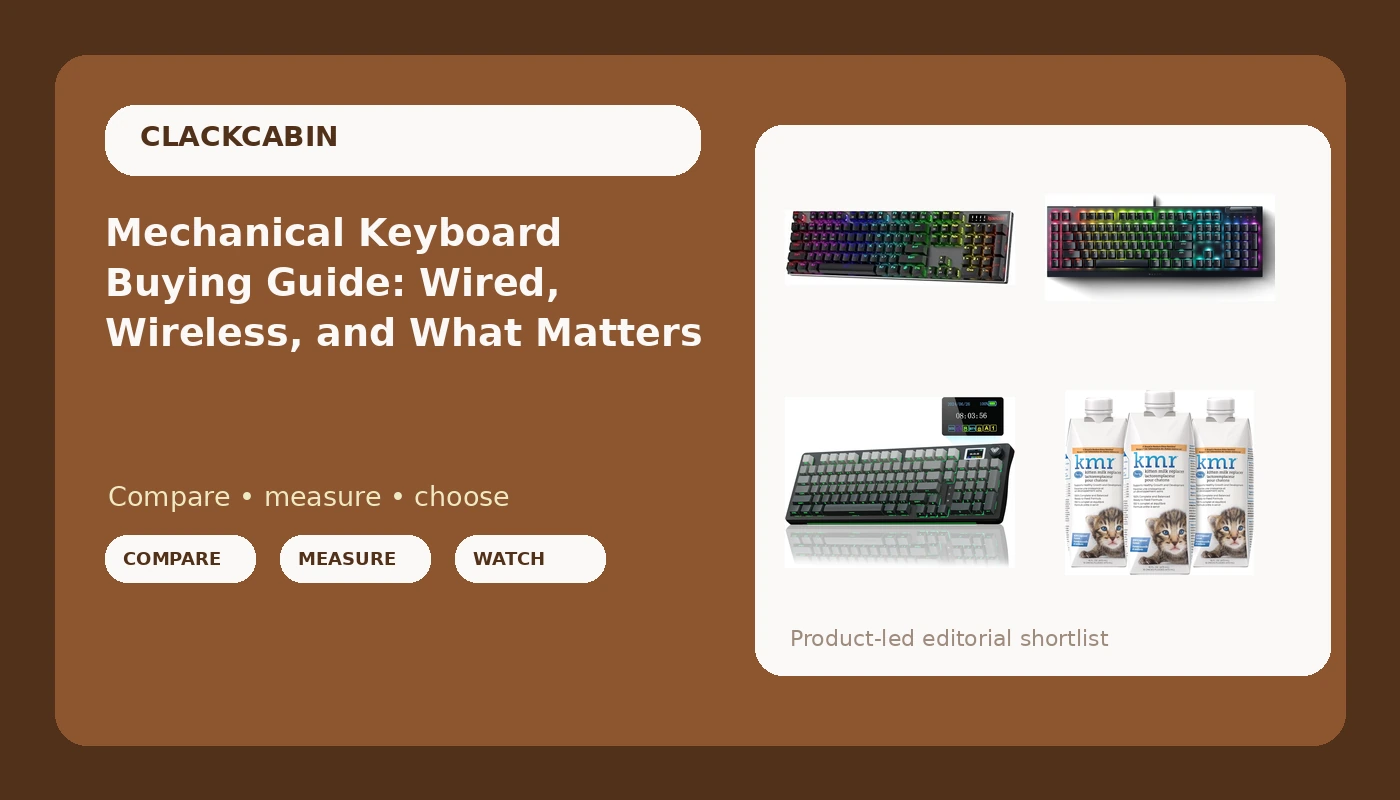
Keyboards are the tool most of us touch more than our phones, and the spec sheets are still written in vibes. "Premium feel" is not a unit. "Thocky" is not a measurement. This mechanical keyboard buying guide exists because the questions that actually decide a purchase are narrower than the marketing: how many keys do you really press, do you need the cable gone, and do you want a switch that announces every keystroke to everyone on your call? Below are four options from the current catalog, three of them keyboards and one of them a kitten milk replacer that is genuinely not a keyboard, handled honestly rather than jammed into a category it does not fit.
Related: Wireless Keyboard Latency: What the Numbers Actually Say →
Quick answer
There is no single best mechanical keyboard, and a recommendation without stated criteria is a guess with a link attached. Match the board to the job: the Redragon K556 PRO is the full-size wireless option with a 104-key layout and an aluminum frame; the Razer V4 X is the tactile and clicky choice with six dedicated macro keys, media and roller controls, and Snap Tap; the AULA S98 Pro is the compact wireless pick with 96 keys, a knob, and an on-board screen. The fourth entry, a kitten milk replacer, is not an input device and belongs in a different cart entirely.
4 useful options
| Model | Best fit | What stands out |
|---|---|---|
| Redragon K556 PRO Wireless RGB Mechanical Gaming Keyboard, 104-Key Aluminum | Number-heavy desks that want the cable gone | Full 104-key layout, aluminum frame, wireless and RGB listed in the name |
| Razer V4 X Mechanical Gaming Keyboard | Typists who want clicky switches and dedicated macro keys | Green switches listed as tactile and clicky, six macro keys, media roller, Snap Tap |
| AULA S98 Pro Wireless Mechanical Gaming Keyboard with Screen, Knob, 96 Keys | Smaller desks that still need arrows and a numpad | 96-key wireless layout with an on-board screen and a physical knob |
| PetAg KMR Kitten Milk Replacer Liquid | Hand-rearing kittens, not typing | Ready-to-feed liquid formula in a three-pack, marketed for newborn kittens to one year |
Full-size wireless: Redragon K556 PRO Wireless RGB Mechanical Gaming Keyboard, 104-Key Aluminum
The case for a full-size board is not nostalgia. If you enter numbers all day, a number pad is faster than a row of number keys, and the arrow cluster stops being a function-layer puzzle. The trade-off is desk width: a 104-key deck takes up roughly the space a compact board and a mouse pad would share, and it pushes your mouse hand further right, which matters more than most people admit until their shoulder complains. Aluminum in the name is worth reading literally, because a metal frame changes weight and resonance compared with a plastic case. What it does not tell you is anything about the stabilizers, the switch brand, or whether the wireless connection holds up across a week of work. Those are things you learn by owning it.
Clicky and tactile: Razer V4 X Mechanical Gaming Keyboard
Clicky switches are the most honest thing in this hobby and the least compatible with an open office. A tactile and clicky switch gives you a bump you can feel and a sound you can hear, which is wonderful alone at home and a diplomatic incident on a shared floor or an unmuted call. The six macro keys are the part worth thinking about, because dedicated keys that do not require a modifier are a real advantage for deploys, snippets, and repeated commands. Doubleshot ABS describes how the legends are molded into the cap rather than how the cap feels, and ABS is the smoother option that tends to shine with use compared with PBT. Snap Tap is aimed at games where opposing directions matter, not at prose.
Compact wireless with a screen: AULA S98 Pro Wireless Mechanical Gaming Keyboard with Screen, Knob, 96 Keys
Ninety-six keys is the compromise layout: you keep the arrow keys and a number pad, you lose some of the spacing between clusters, and you get back a few inches of mouse room. For anyone working from a laptop stand with a single monitor, that is usually the right trade. The knob is the other reason this layout keeps winning converts, because a physical dial for volume is faster than a media key and does not require looking down. The screen is more debatable. On-board displays are useful for connection mode, battery state, or a profile name, and they are also a thing that can be bright, distracting, or simply ignored after week one. Wireless in the name says the cable is optional. It says nothing about latency or dropouts.
Not a keyboard: PetAg KMR Kitten Milk Replacer Liquid
This one is not a keyboard, and pretending otherwise would waste your time. It is a ready-to-feed liquid formula in a three-pack, with vitamins, marketed for newborn kittens through one year of age. It belongs in a cart for someone hand-rearing an orphaned litter, not on a desk. It appears in this guide because it arrived in the same product catalog, and the honest move is to say so rather than dress it up as an accessory. If you are fostering neonatal kittens, a ready-to-feed liquid removes the mixing step that powdered replacers require, which matters at 3 a.m. on a feeding schedule. If you are shopping for a keyboard, skip this entry.
Prices and availability may change, and the details above reflect what each product states about itself. No price, rating, stock status, or measured result is asserted here; check the retailer page for current information.
Layout math: what 104 keys and 96 keys actually change
Layout is the decision you cannot fix later. Switches can be replaced on hot-swap boards and keycaps can be swapped, but the number of keys is baked into the case.
A full 104-key layout gives you the main typing cluster, the arrow keys, and a dedicated number pad. That is the right choice for spreadsheets, data entry, and anyone who relies on numpad shortcuts. The cost is width plus the mouse sitting further from your shoulder.
A 96-key layout keeps the arrow cluster and the number pad but compresses the spacing and removes the gaps between sections. You lose a little muscle memory at the edges and gain back two or three inches of mouse room. It is the layout that fits a small desk without giving up the numpad.
Tenkeyless and 65 percent boards are the other common stops, and they are correct when you never touch a number pad. The rule I use is simple: count how many times you pressed a numpad key last week. If the answer is more than a handful, buy the numpad. If it is zero, stop paying for it.
Switch feel: tactile, clicky, and what the marketing leaves out
Three words do most of the work in switch descriptions, and only one of them appears in the product names above.
Linear switches travel straight down with no bump. They are the quietest option and the usual choice for shared offices and late-night typing.
Tactile switches have a bump partway down that tells your finger the press registered. They are quieter than clicky switches because the bump is felt rather than announced.
Clicky switches combine that bump with an audible click. The Razer V4 X names Green switches described as tactile and clicky, which places it firmly in this category. The click is the point for some typists and the dealbreaker for everyone within earshot.
Two more terms matter when you read a listing. Actuation point is how far a key travels before the press registers, where a shorter distance feels faster and a longer one feels more deliberate. Doubleshot keycaps, listed on the Razer, describe how the legend is molded into the cap so it does not wear off, which is a durability claim rather than a feel claim. Neither term tells you how a board will sound after a year, which is why sound is the last thing I trust from a spec sheet.
How to choose in five steps
- Count your numpad usage for one week. It decides the layout before anything else does.
- Decide whether the cable can stay. Wireless is worth it if you move the board or hate cable management, and it adds one more thing that can fail.
- Pick switch feel for the room you type in, not for the video you watched. Clicky switches are wonderful and antisocial.
- List the keys you press that are not letters: volume, mute, screenshots, deploy commands. Dedicated media controls and macro keys are the features you will actually notice.
- Check the return window before you order, because layout and switch feel are the two things no review, including this one, can settle for you.
Practical guidance before you order
- Measure your desk first. Full-size boards are wider than most people picture, and a 96-key board is the compromise when the mouse is already crowded.
- Budget for the second purchase. Keycaps and a switch puller are common follow-ups, and hot-swap sockets decide whether that is even possible.
- Do not buy a board for its lighting software. If the app requires an account to change a color, that is a permanent annoyance attached to a temporary feature.
- Choose the switch you can live with at 2 a.m. on a shared floor, not the one that sounds best in a recording.
- Keep the packaging for the first two weeks. Returns are easiest before the box is gone, and layout regret shows up fast.
Which option should you choose?
Choose the Redragon K556 PRO Wireless RGB Mechanical Gaming Keyboard, 104-Key Aluminum when you want a full number pad, an aluminum frame, and no cable on the desk. Choose the Razer V4 X Mechanical Gaming Keyboard when you want tactile and clicky switches, six dedicated macro keys, and media controls you can reach without a modifier. Choose the AULA S98 Pro Wireless Mechanical Gaming Keyboard with Screen, Knob, 96 Keys when your desk is tight but you still need arrows and a numpad, and you like a physical knob for volume. Choose the PetAg KMR Kitten Milk Replacer Liquid only when you are hand-rearing a kitten, because it is a three-pack of ready-to-feed formula and not an input device.
None of the details above come from a bench session on these units. They come from what each product states about itself, which is the correct starting point and not the finish line. Layout and switch feel are the two things you have to settle with your own hands, and no listing can do that for you.
The bottom line
The mechanical keyboard market rewards patience and punishes guessing. Three of the four options here map to a clear job: a full-size wireless aluminum board for number-heavy desks, a clicky tactile board with macro keys for people who want feedback and dedicated controls, and a compact 96-key wireless board with a knob and a screen for smaller setups. The fourth is a kitten milk replacer, which is a fine product for a foster kitten and a terrible keyboard.
Pick the layout first, because it is the one decision a later upgrade cannot fix. Then pick switch feel for the room you actually type in, then decide whether the cable matters. Everything else, including RGB and on-board screens, is a preference you can live with or ignore. And if you are hand-rearing a litter, buy the formula and the keyboard separately, because neither one does the other's job.